Chico Mendes Reserve
Land-Cover Atlas
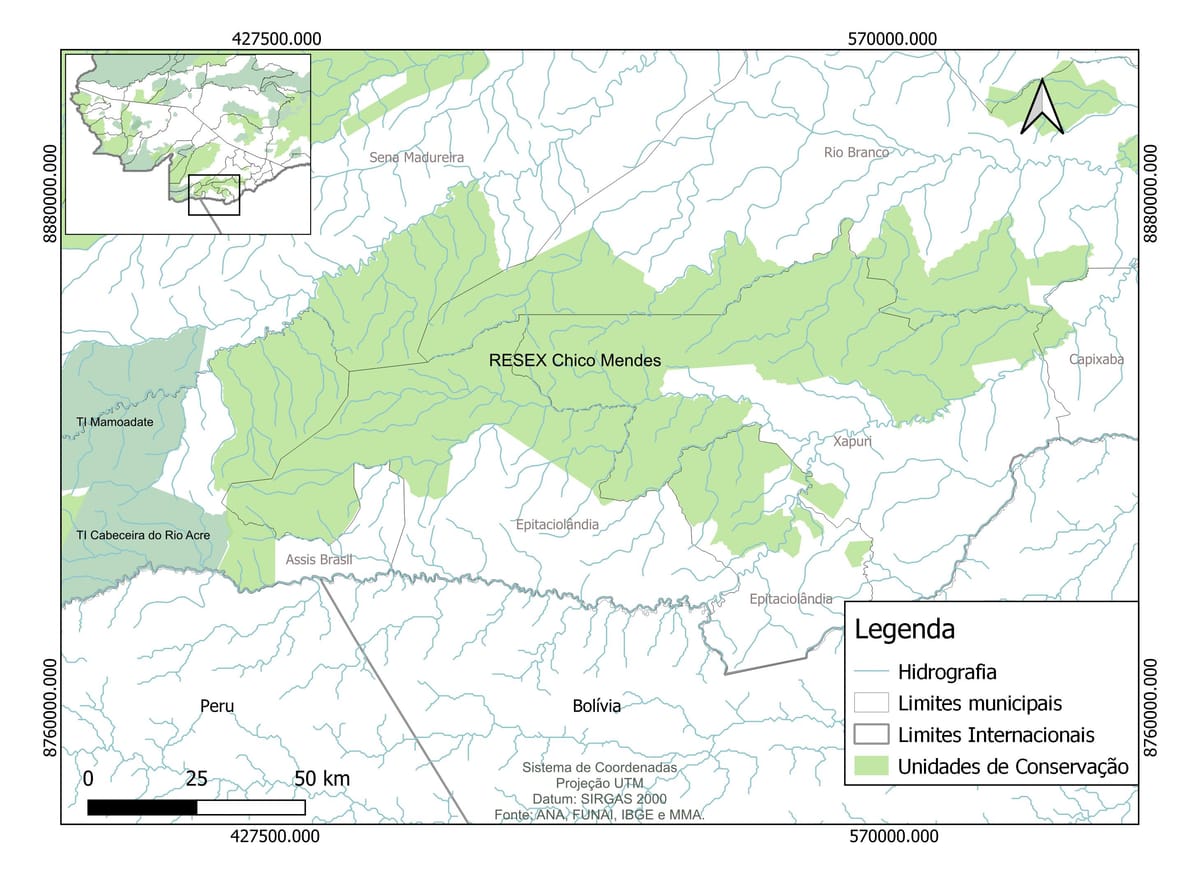
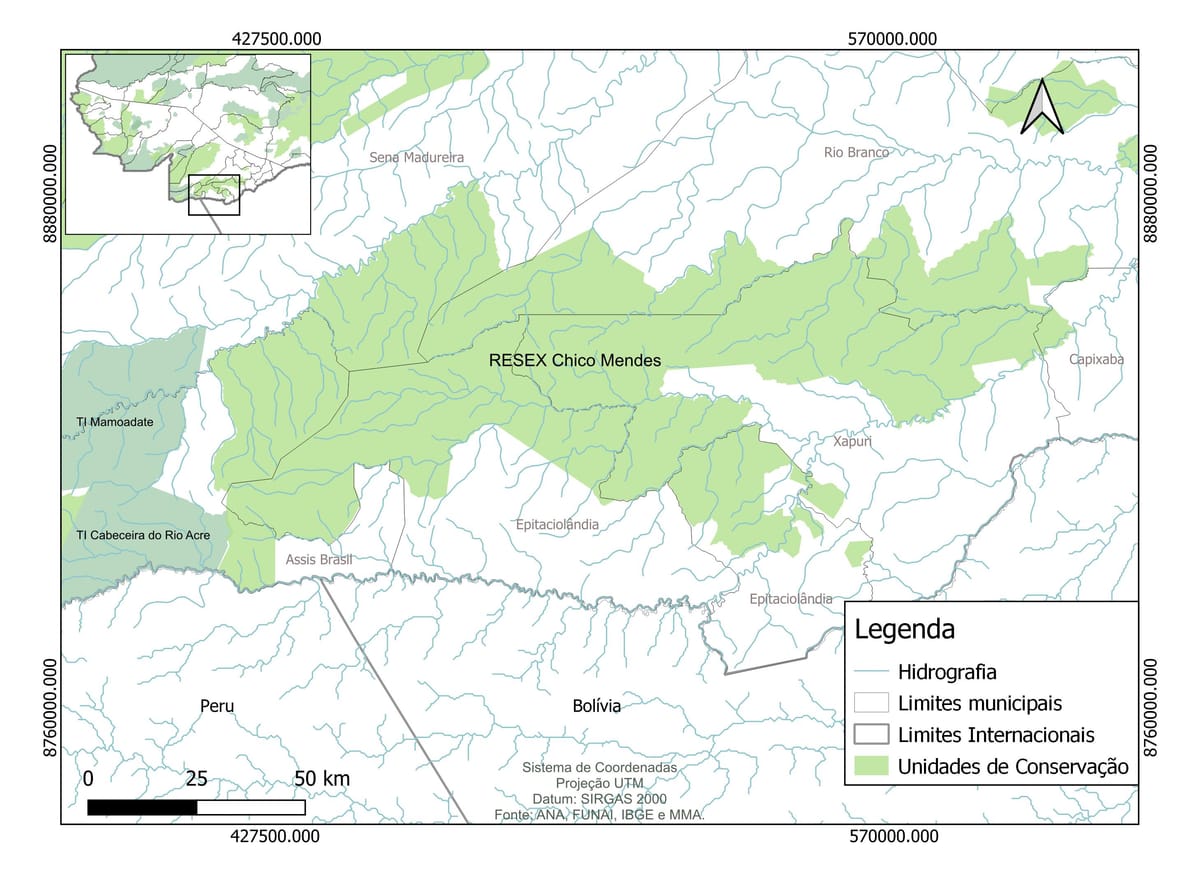
Reference plate (left) and 1985 land-cover classification (right). QGIS · MapBiomas Coll. 8 · SIRGAS 2000 / UTM · A3 print-ready.
Challenge
Thirty-seven years of land-cover change inside the Chico Mendes Extractive Reserve had never been visualised as a structured temporal atlas. The reserve, established in 1990 after the assassination of Chico Mendes, sits at the Brazil–Peru–Bolivia triple frontier, one of the most biodiverse and politically sensitive landscapes in the Amazon. Understanding how illegal deforestation, road construction and agricultural expansion had changed the reserve's internal land cover required integrating multiple years of satellite-derived data into a legible, publication-ready narrative.
Data sources
- MapBiomas Collection 8, land-cover classifications, 1985–2022
- Google Earth Engine, cloud computing and band analysis
- ANA, FUNAI, IBGE, MMA, hydrography, indigenous territories, administrative boundaries
- PRODES, deforestation annual increments as verification layer
Methodology
- Downloaded MapBiomas Collection 8 rasters for the Chico Mendes RESEX boundary for six time steps: 1985, 1995, 2005, 2015, 2020, 2022.
- Reclassified land-cover classes to a five-category schema: native forest, secondary vegetation, agriculture/pasture, water bodies, other.
- Computed area statistics per class per year in Google Earth Engine.
- Designed cartographic plates in QGIS with a consistent colour schema across all time steps.
- Prepared a scrolling narrative atlas, pairing map frames with interpretive text.
- Verified 2020–2022 change with PRODES annual deforestation polygons.
Key findings
- The RESEX interior held remarkably well between 1985 and 2005, the reserve boundary functioned as an effective deforestation barrier.
- Between 2005 and 2022, the BR-364 corridor and secondary roads east of the reserve generated "fish-bone" deforestation patterns reaching the reserve's buffer zone.
- The eastern flank shows the first signs of internal agricultural encroachment by 2022.
- Secondary vegetation recovery is visible in some previously cleared areas, suggesting partial agroextractive management.
Deliverables
- 6 cartographic plates, QGIS, print-ready A3, SIRGAS 2000 / UTM
- Statistical summary table, area per class per year
- Scrolling web atlas with interactive frame progression
- Source data package with methodology notes
Tools
Outcome
Submitted as the undergraduate monograph at UFAC (2024). The atlas became the first systematic temporal analysis of Chico Mendes RESEX land cover at this resolution. The scrolling web version is embedded in the Forestana portfolio,see it in action on the home page.